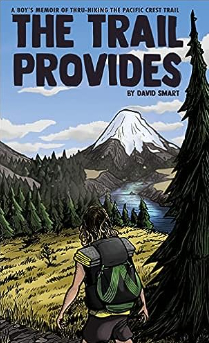
David Smart is a 24-year old millennial stuck in an uninspiring digital marketing job after college. Finding the corporate lifestyle devoid of purpose, he ditches the position and searches for an alternative. Frat brother Bradley has a plan: Hike the Pacific Crest Trail. Feeling he’d never stuck with projects in his youth, Smart signs on in search of more adventure, challenge, and meaning than his previous life. He finds it, though what ensues is more a coming of age than trail story.
If you’re looking for the traditional thru-hiker story arc from hiking newbie to hardened ultralight trail pro, search elsewhere. These guys begin with no camping experience and are still figuring things out 3,000 miles later. Some of their decisions strain credulity and threaten the reader’s sympathy: Hiking 70 miles barefoot. Foregoing a tarp or tent. Leaving behind the water filter and maps. Losing the trekking poles. When they run out of water and later hike into a snowstorm, only youth and luck save them.
But this is more than a trail story. The second half of the book in particular is much more about the duo’s relationships and town sorties than actually hiking. Smart might be an average hiker, but he’s a deep thinker and we get a seat inside his head as he begins to work out the problems of his young life. His personal reflections and relationships are probably more compelling than any trail story he could write.
Those begin with the enigmatic, conflicted, self-inflated Bradley. Together they form an odd couple of the trail. Smart trusts Bradley to plan the details of the hike, which immediately turns sour when the food rations prove insufficient and often inedible. Bradley’s judgment proves dubious on numerous other occasions whether it involves barefoot hiking or exploring off trail. Fortunately Bradley has a metaphysical streak and often comes up with inspiring aphorisms to get the team through a day or night of deprivation. Unfortunately Bradley’s retrograde habits put the lie to his enlightened persona and Smart begins to lose patience with his friend. Just as their trail relationship threatens a permanent breakdown, the two commit to a painfully intimate heart-to-heart and their veil of separation is lifted. Bros for life.
It’s in these philosophical moments that the book and Smart’s writing really shine. Freed from the baggage of barefooting, his epiphany about wearing shoes becomes a metaphor for finding and expressing his unique self. A mushroom trip becomes a reminder of the physicality of hiking. The book takes an internal shift when Smart is alone on the trail for the first time. The solitude forces him to know himself more truly: “I sat at the bank of my mind to watch the river run its course.” The more he leaves behind on the trail, the more connected he feels to himself. In the end he learns to love that self and accept its pain.
As he nears the end of the trail, fears arise, like an old man facing the end of his life. Until this adventure, it was foreign to Smart that he could create his own life. Now he knows better. He has control of his next chapter. Both Bradley and the trail have taught him to embrace risk. He opens his eyes to a new purpose, inspiring others, and spends three years writing this book.
The critical reader can easily point to flaws in his labors. There are logical lapses and factual mistakes. (Cheryl Strayed’s Wild is a memoir not a novel.) The language is sometimes stilted and platitudes are plentiful.
And yet this is a compelling story. Many scenes are well set—a dice game, a dumpster diving session, climbing Mount Shasta—and the dialog is engaging and meaningful. Characters come to life.
The Trail Provides passes the real test: It’s an interesting story about interesting people. Smart’s humor, humility, and sincerity pulled me in.
 Trail Memoir
2 responses to “The Trail Provides”
One of the best distance hiking stories I have read. Have you heard about his second book, True Nature?
LikeLike
Thank you for sharing 🙏
LikeLiked by 1 person