
Colin Fletcher was my first outdoor hero and perhaps also my first literary one. As I prepared for my long-distance backpacking trip at Philmont Scout Ranch, age 14, a scouting buddy confided that I must study The Complete Walker. It was the backpacking bible of the early 1970s. I was immediately taken by the cover photo showing the author’s extensive and colorful gear laid out in tidy order. Inside the book I was even more captivated by his meticulous hiking systems and equipment evaluations.
But what captured me most of all were the glimpses into his outdoor experience. His classic essay titled “A Sample Day in the Kitchen” enchanted me with the possibilities of outdoor living. He begins before dawn when “Something stirs inside you, and you half-open one eye.” From there he walks you through a normal day backpacking (as Colin Fletcher) in perfect detail, ending with “…you zipper and draw-string yourself into the bag, wind your watch, remind yourself what time you want the something inside you to stir in the morning, and go to sleep.”
When bears weren’t a concern, Fletcher advocated cowboy camping with pack as backrest, cooking and dining in your sleeping bag, storing food overnight in your pack. He called it his “Fletcher in-sleeping-bag culinary system.” His zest for the experience was infectious, though to this day I’ve never camped that way.
There is no denying the magnitude of Fletcher’s hiking achievements: walking the length of California in the 1950s, becoming the first person to traverse the Grand Canyon below the rim. It’s clear in retrospect that Fletcher downplayed his prodigious physical strength, inviting his readers along on vicarious journeys that few could do on their own.
It turns out that Fletcher was a Royal Marine Commando in WW II and saw substantial action in special operations. This was a guy who could sleep on the ground with no gear in sub-freezing temperatures and rise the next day for hand-to-hand combat. But you’d never know it by reading his literate, witty, often self-effacing prose.
After the war Fletcher became a global citizen, working in Africa for a while, then migrating to Vancouver, finally landing in California. Later in life, he settled on a rural street in Carmel, California.
Fletcher saw himself as a writer first, walker second. He was as amazed as anyone when his writing on the how-to of backpacking became a bestseller among outdoors people.
I would categorize Fletcher’s books into two phases. His first three books were masterpieces:
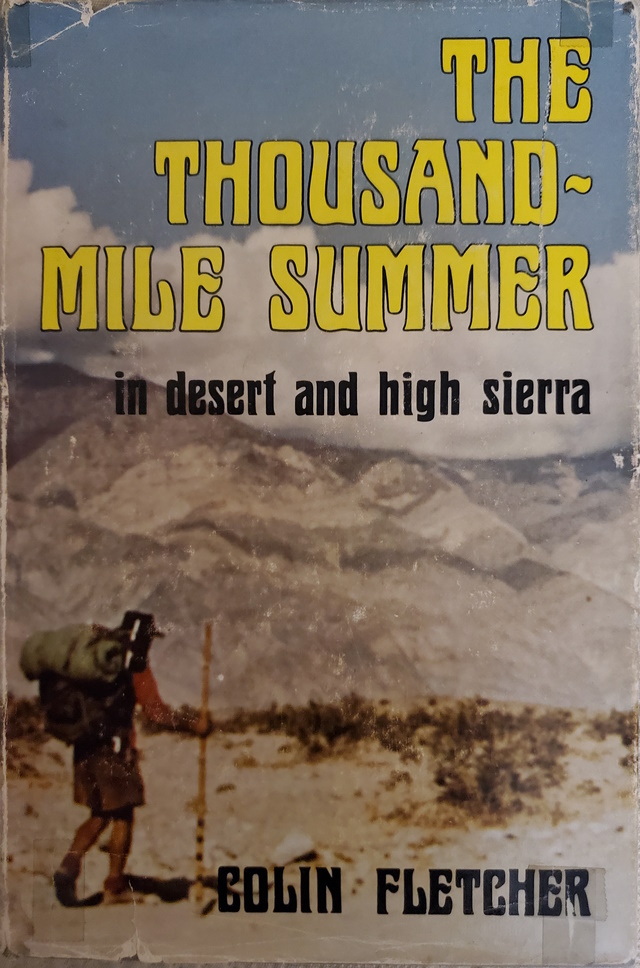
- The Thousand Mile Summer — recounts his groundbreaking hike up the length of California in the 1950s
- The Man Who Walked through Time — recounts his equally groundbreaking hike of the Grand Canyon
- The Complete Walker — became the backpacking bible for the baby boomer generation
With the income from these books, Fletcher went on to indulge in more personal, less popular projects:
- The Man from the Cave — a detective story that unearths the life of a turn-of-the-century desert hermit whose secret cave Fletcher stumbled across on one of his desert rambles
- The Winds of Mara — recounts Fletcher’s return to Africa and an animal preserve in Kenya
- River — recounts his last major adventure, a journey by foot and small boat down the Colorado River from source to sea
- The Secret Worlds of Colin Fletcher — a collection of Fletcher’s essays, mostly related to solo hiking, and his last book
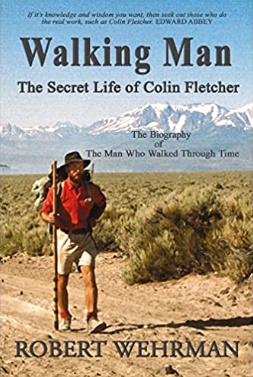
Most of what I know about Fletcher’s private life comes from the excellent biography, Walking Man, by Robert Wehrman, the definitive work on Colin Fletcher. It covers the full span of Fletcher’s fascinating life and puts his books and adventures into context with many facts and events previously unknown to his readers.
Wehrman’s book is well-organized, easy to read, and even inspired on occasion — such as when describing how Fletcher came to realize his own life’s purpose. The biography helped me reconnect with this important figure in my life. It’s a gift to the generation of walkers who were taught and influenced by Colin Fletcher.
Fletcher’s tragic final years, disabled by an auto accident, remind us all to “seize the day,” which he certainly did throughout his long life. While there were a few things he wanted to accomplish and did not, the fact is that most of us would be more than grateful to have under our belts just one of his dozen or more great adventures. Not to mention his creative output: All of his books are fascinating, and several are classics that influenced a generation and continue to sell to this day.
Fletcher was known to be a curmudgeon at times. He was famously antagonistic toward fans who showed up on his doorstep. But he had a special relationship with and concern for his readers. In fact, I can personally vouch for Fletcher’s character in this regard:
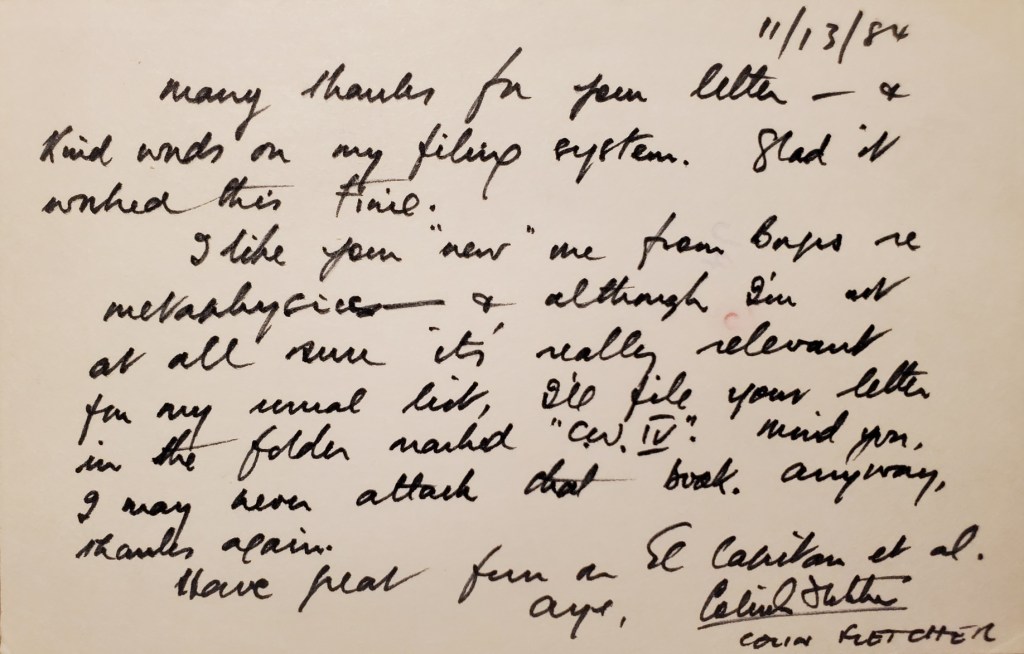
As a teenager, I was entranced by The New Complete Walker. In 1977, I wrote Fletcher a short letter and included some of my own favorite “Quotes for Contemplative Walkers.” What a thrill to receive back a polite and thoughtful postcard from the man himself, saying he would add my letter to his file for “CWIII” — no promises of course.

And I was thrilled seven years later when I purchased The Complete Walker III and found, not only some of my quotes, but my name in the book’s acknowledgements. I wrote Fletcher again, complimenting him on his filing system, and again received a thoughtful and kindly postcard reply.
When you reach a certain age, you begin reconstructing where you came from. Turns out, Colin Fletcher was one of the great influences of my life. Whether it’s backpacking gear, solitude outdoors, environmentalism, or writing, I see now that my viewpoint began with Colin Fletcher.
 Trail Memoir
One response to “Author Profile: Colin Fletcher”
Different subject: I wrote Sir David Attenborough a letter about a hummingbird that thought my bright white hair was a flower. My hero wrote me back.
Great article.
Susan
LikeLike