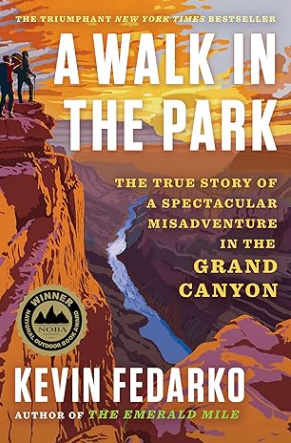
In A Walk in the Park, former whitewater river rat Kevin Fedarko traverses the Grand Canyon on foot in a journey of self-discovery. Fedarko, author of the award-winning The Emerald Mile, showcases his writing and wilderness talents with a mammoth work that feels like several books in one. Along with natural and human history, there are multiple expeditions into and through the greatest canyon on earth.
Along the way, Fedarko profiles a string of memorable canyon characters, starting with the inimitable Colin Fletcher, the first person to attempt a thru hike of the canyon, whose The Man Who Walked Through Time influenced both Fedarko and me as kids. Then there are a couple of Flagstaff professors who gave much of their lives to exploring the canyon. Add Kenton Grua, hero of The Emerald Mile boating story, whose attempts to cross the Grand Canyon on foot were equally remarkable. And finally Rich Rudow, the leading modern explorer of the canyon’s backcountry.
Fedarko also weaves in some of his own backstory, starting with a striking portrait of his youth in grimy Pittsburgh. He touches on his late 30’s career shift into whitewater rafting and his early attempts at journalism. Fedarko also brings in his relationship with his father, who first exposed him to the Grand Canyon with Fletcher’s book. At the end is a bittersweet section where Fedarko brings his dying father to see the canyon for the first time.
But the pulse of Fedarko’s book lies in the serial expeditions into the canyon as he and irascible partner, photographer Pete McBride, attempt to traverse the entire park. We are reminded of the complexity of such an enterprise: due to sprawling and plentiful side canyons, the thru-hiker must cover three times the distance as the crow flies through the canyon, a trek of more than 700 rugged miles. Serious challenges abound: slot canyoneering and its special blend of danger and magic, life-threatening injuries, and a potentially lethal winter storm. Plus the ever present threat of running out of water in desert heat.
At a critical juncture, Rudow proposes a bold plan, a new route across the rock mapped using Google Earth. This will liberate the party from jungle warfare along the river with its dense vegetation, traveling instead on rock ledges far above. The plan features an even more critical element: it requires relying on hidden water found in small potholes and niches in the rock. Though not emphasized, this would be impossible without previous exploration and modern satellite mapping technology.
The book is filled with vivid description, exhilarating action, and literate writing that keeps readers engaged. The deep descriptions of nature and natural history will also keep the scientifically-inclined interested. And there are ample opportunities for Fedarko to show off his gifted pen: a rich description of the canyon’s heat, a glorious sunset with more colors than I knew existed, and springs that are “pocket-sized miracles.”
The multiple expeditions with different points of view are sometimes challenging to follow, but most of the book flows easily. Dramatization occasionally went over the line for me. For example, it was hard to believe that Fedarko and McBride were newbies to the extent initially portrayed. And the help they received inside the canyon and out was a little mysterious until we remember this was a journalistic team working for a major publication that had in its power to publicize the canyon for better or worse.
The latter half of the book weaves in the important native American perspective, reminding readers that a number of tribes called the canyon home for millennia before Europeans arrived. An emotional Havasupai woman, grieving for her displaced people, bestows ceremonial pouches for the team to carry, encouraging them to slow down, listen, and observe. Then there is the fascinating and disturbing account of the Hualapai’s commercialization of helicopter tourism at the western end of the park.
Finally, Fedarko honors his predecessors in the canyon by choosing to leave his traverse incomplete by a few hundred yards. Similar to the “spirit line” in a Navajo rug, it’s a mark of humility. His book though is more than complete: It’s comprehensive, entertaining, personal, and instructive, all at the same time.
 Trail Memoir