
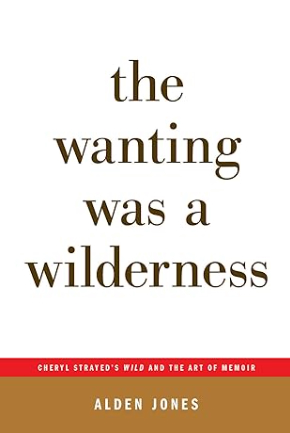
When I first became interested in writing a trail-based memoir, I went looking for some sort of critical analysis of Wild, the iconic book in the genre. What I found was Alden Jones’ The Wanting Was a Wilderness: Cheryl Strayed’s Wild and the Art of Memoir. Jones’ book is a singular mixture of criticism, how-to, and memoir that will give you a deeper understanding of how Wild is constructed and stretch your mind in useful directions if you too have an interest in writing memoir.
Jones is a writer and educator, the author of two memoirs and a short story collection, and a teacher at Emerson College. And she too has an outdoor adventure story to tell. She writes, “If Strayed’s ‘story’ was one of combating an inconceivable sorrow, armed with the grit, mine was the quest for grit, armed with the gear.”
In the middle of college, Jones experiences a personal crisis. Looking for enlightenment, she embarks with a crew of 12 on a three-month Outward Bound expedition in North Carolina, Florida, and Mexico. Physical hardship and personal drama ensue, including Jones’ electrifying attraction to another girl.
The experience leads her to write a book about how being in the wild can give us the opportunity to change or understand our lives. And then she marries that book to an in-depth deconstruction of how Cheryl Strayed created literary magic in Wild.
Jones begins by reminding us of the relatability of Strayed’s central character and how the story of that self illuminates our own stories of self.
Wild exists in opposition to traditional adventure tales of grizzled and experienced men (usually) conquering the wilderness. Rather, it’s the tale of a normal person in the wilds. Strayed’s character is not better or smarter than the average reader. “The tone of authenticity and self-awareness makes it feel she is being real with you,” Jones writes.
Further, Jones observes, that character gives us the impression that she would not judge us for our own mistakes made while in an emotional state. This makes a wide range of readers feel welcome in the story, contributing to the book’s commercial success.
The inspirational message ultimately delivered by Wild is that any normal person can eventually become her own role model or heroine.
The technical heart of Jones’ book for aspiring memoirists is in her perceptive explication of Strayed’s art.
Jones points out how Strayed begins compellingly by dropping us into the middle of her story, stuck on a mountaintop without functional hiking boots, forcing readers to consider how she got there, and what she will do next.
Strayed manufactures tension, creates a “mission,” and weaves memories into the hiking action in order to give her story its texture and allure.
Consistent with her character, Strayed writes simply, inspiring trust. But she also takes risks with readers in describing her risky behavior during her grief. This further reinforces her forthright persona, though it also risks losing some readers. Strayed generates sympathy for her vulnerability, but also admits responsibility for her own mistakes.
Jones shows how Strayed uses a bookending technique to maintain the trail as Wild’s primary thread. For example, Strayed brings readers into her motel room the day before she sets out, grounding us in the details of her preparation for the hike, then uses a piece of gear as a trigger for a memory that leads into a flashback.
Such object or action triggers are her method of interrupting the chronology with memories of what’s gone wrong in her life to bring her to this point, while maintaining an otherwise cohesive narrative structure.
Jones leavens her analysis of Strayed’s style with plenty of her own tips and techniques, seamlessly woven into the book’s several themes.
When preparing for a travel book or memoir, she recommends her students record details along the journey, but without a story agenda. The story that ties together events can emerge much later. In the case of Wild, Strayed’s story—her triumph over grief—didn’t fully emerge for more than a decade.
Jones points to choosing and fashioning a clear persona as fundamental to a successful memoir. Mary Karr makes a similar point in emphasizing voice. Jones likens the task to “cutting a channel through the vast field of your personality.” Without that step, a memoir is in danger of becoming unstructured and unfocused.
For those of us tempted to document every detail of our life or adventure, creating a chronological summary with little sense of a forward-moving story, her advice is to state your message or point explicitly. Sound structure is the natural result of knowing what you want to say in the end.
The self-examination of a successful memoir also requires accountability—a hard look at one’s past self. Jones argues that telling the truth is much more important than being likable, if you want to be truly free to express yourself. Strayed wagers likability, confessing her promiscuity and drug use, in order to arrive at a truer truth. And that gamble is key to both her redemption and her book’s inspirational power.
Midway through writing this book, Jones faces a huge life upheaval—the disintegration of a marriage along with the demands of mothering three young children. After time away to deal with her personal life, she returns to complete the book with renewed perspective.
She writes, “At the end of writing a memoir, you’ve created order out of your chaos, you’ve controlled it and made sense of it …. and hopefully come to understand yourself better in the process. The persona in Wild is someone we are confident has met resolution.”
Jones finds resolution in the multiple threads of her ambitious book too. At the end of her Outward Bound excursion, she rappels down vertical Table Rock, a moment of “peak aloneness,” observing that the hard part was just beginning.
Much later in life, she finds the courage to jump out of a constraining family structure, discovering that the journey to solid ground is another long one. But that journey produces this book, one that “was meant to be written, the truest truth I could offer you.”
 Trail Memoir