

There are many tales of the Appalachian Trail out there, but none quite as down-to-earth as Sticks and Stones: How to Hike the Appalachian Trail in Thirteen Years. Diana “Sticks” Harsha represents the casual hiker in that she’s not looking to set records or overcome gargantuan obstacles. She’s not superhuman—she simply likes to hike.
Harsha breaks down the trail into segments that are easy to follow. As a working mother, she starts off slow, only tackling sections of the trail close to home. Sometimes she recruits friends to accompany her. But none of her friends are superhuman either, and their inexperience adds to the authenticity of Harsha’s journey.
One thing that stuck out to me immediately is all the practical tips and interesting trail tidbits Harsha incorporates as she starts off from Springer Mountain in Georgia. She offers advice and goes in depth with logistics, as if laying out the groundwork for those seeking to hike the AT themselves. Her attention to detail is appreciated, and I can often see myself hiking along with her.
The real beauty of Harsha’s writing is that she takes her time. The pace matches her hiking style in that it’s slow and steady. I found that I often read the book in segments—much like she hiked the AT. I could pick it up again at any time and not feel lost in the journey. However, I did feel a ramping up towards the end. This might be due to Harsha becoming more of a solo thru-hiker, covering long sections away from home.
Her challenges in the White Mountains became more the stuff of adventure, and she proved herself tougher than I gave her credit for. Her tenacity impressed me, especially when it took her eight hours to traverse one mile on a particularly tough section. The Vermont segment was absolutely brutal—it almost broke her. This makes good memoir material though, and I enjoyed reading as she prevailed over her struggles.
Another aspect of her story I enjoyed was how she bonded with her daughter, Melanie. A surly teenager at the beginning of Harsha’s journey, Melanie soon joins her mother on some segments. She then decides to tackle the entire trail on her own. Harsha’s pride is felt when her daughter not only completes the AT, but goes on to hike the PCT.
Harsha injects humor in her tale, which makes for easy reading. I particularly enjoyed the interchanges with fellow hikers, trail angels, and the people who tote her to trailheads. Many times, the interchanges are more interesting than the trail itself. One of my favorite anecdotes involves a little boy with his dad, transporting Harsha to a trailhead. When the boy asks her name, Harsha answers “I’m Sticks” giving her trail name. The boy thinks it over for a moment before responding “I’m three.”
What I thought was going to be a practical guidebook for a piecemeal hike on the AT became more, with heartwarming exchanges and personal triumph along the way. Harsha’s memoir might not be a fast-paced page-turner, but it’s got heart. Not to mention the great stick-figure art on the cover.
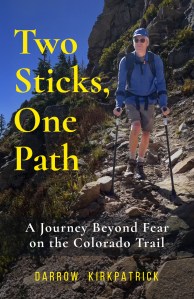
 Trail Memoir