
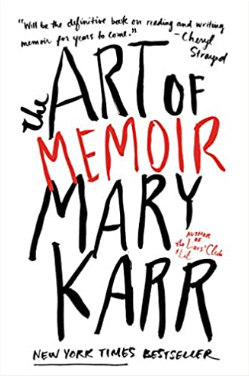
Mary Karr is the bestselling author of the 1995 memoir The Liar’s Club. She’s also published five volumes of poetry and is a professor of English Literature at Syracuse University, where her students have included Cheryl Strayed. With those credentials you might expect a highfalutin literary voice in her book on memoir, but far from it. This plain speaking, Texas-drawling, writer of hard life experience calls herself “blue collar” and lives up to the label.
When this book was first recommended to me I envisioned how-to checklists and brainstorming exercises for recalling and organizing my past. My own memoir is well past those stages, but still needs help. Fortunately Mary Karr seems to have read my mind. Her book is not a “how-to” in the mechanical sense. Rather it’s two-thirds critique and commentary on great memoirs and one-third thoughts on how to write one. Karr shows us what makes memoirs great, then reminds writers to do the same.
Popular, high-quality memoir has taken off in recent decades. For me, immersed primarily in trail memoir, The Art of Memoir provided valuable perspective on the larger world of memoir. It made me feel part of a literary movement—one with merit and relevance. The highest praise I can offer the book is that I couldn’t put it down. I listened to most of it non-stop on one day of a long road trip.
Karr gives us synopses and critical commentary on important memoirs such as Richard Wright’s Black Boy, Vladimir Nabokov’s Speak Memory, Harry Crews’ A Childhood, Frank Conroy’s Stop-Time, Maya Angelou’s I Know Why the Caged Bird Sings, Maxine Hong Kingston’s The Woman Warrior, and Michael Herr’s Dispatches. It’s a crash course in the great memoirs of our time.
A common theme is that these literary giants get away with techniques we normal writers can’t use. Nabokov has his soaring vocabulary, Maxine Hong Kingston her vivid fantasy. Karr seems to suggest “don’t try this at home,” and yet she also encourages us to lead with our own talent, which always trumps the rules. Her message is to remain humble while fighting to showcase your best.
I loved her stirring defense of truth in memoir. If we don’t demand the truth to distinguish the genre, then what defines it? Karr outs several dishonest memoirs with frankness and humility, including one that fooled her. The truth doesn’t always make for the better story. But it offers one unassailable strength: If another human could actually overcome this—fill in the blank—then the reader could too. Memoir is empowering and healing.
Yet Karr never pretends that memoir is literal, scientific truth. It is always filtered through the imperfect memory and lens of a fallible human being. Intent is key. Is the author trying to honestly and accurately portray their own memories, knowing that memory is imperfect? Karr finds acceptable such techniques as reconstructing dialog or renaming characters. But she finds wholly unacceptable exaggerating or inventing events. She also warns that creating a false self, one that is smarter or more noble than the actual, will ultimately be unconvincing to readers. And that’s the most important downside of lying or exaggerating in memoir. In the long run, it fails to produce a book of depth and conviction.
When Karr offers advice to would-be memoirists, the tips are pointed and practical, reflecting her deep experience both writing and teaching the genre. Early on she offers a brief test for would-be memoirists. Do you have a bad memory? Are you too young or are the events too recent? Are you writing for your own therapy instead of for readers? Are you unable to change your mind as you explore events? Do you hate revising? These questions will be a helpful reality check for many.
Later in the book, Karr does offer some checklists, but they are short and practical. For me, most of her suggestions invited simple reactions of “Yes, been there/done that,”—to keeping a journal and quotes, writing reviews (like this one), painting a physical reality using the senses, or “Bingo! I need to do that”—to setting emotional stakes, hinting at an inner enemy, establishing “looking back” and “being in it” voices.
I found Karr’s tips for staging a memoir invaluable. She argues that the earliest pages must hint at what the book will hold, and should quickly manifest the essential inner conflict. They should show what’s at stake emotionally, what’s at risk and why is the writer passionate about it. Else, why would the reader continue? What could they learn or discover?
She suggests identifying an inner enemy to organize the memoir around. From there, she advocates for a simple, chronological structure. Though she makes an exception for the “flash forward” technique she used to start all three of her memoirs. That technique can be helpful in portraying the psychological stakes at the start of the book. But, and I speak from experience, it can be devilishly hard to get right.
When it comes to the essence of vivid writing, Karr advocates early and often for “carnality.” This is her term for telling a story through the five bodily senses. What did the writer see, hear, smell, taste, and feel? She goes so far as to call carnality “sacred,” making the case that it’s essential to communicating any human experience.
Observing that lack of a distinct and emotionally rich voice is one of the main reasons that memoirs fail, Karr argues for the importance of finding a unique voice to “conjure the human.” That’s no simple feat. It could take months or years of writing to create the requisite tone or dialect or point of view. One technique for discovering that voice is to think of writing a letter to a specific individual. How do you “arrange yourself for different audiences”? Finally, that voice should probably evolve over the course of a story to supply some of the evidence for a transformed self.
Karr comes off as a merciless revisionist. She tells of writing dozens of drafts. She admits to spending nine months on a first chapter. Her ardent references to throwing away work, cutting work, and revising what’s left, for years if necessary, is a powerful argument against the notion that good writing ought to happen spontaneously in the first draft.
The Art of Memoir wanders from pointy-headed literary criticism—Nabokov’s use of language, to low-level mechanical advice—writing longhand. But that’s also the beauty of it, covering the subject from head to toe, with an emphasis on great examples. As a working memoirist, I found every chapter helpful. Mary Karr has captured in one book the wisdom of a long career of reading, writing, and teaching memoir, and created an invaluable resource for aspiring writers.

 Trail Memoir