
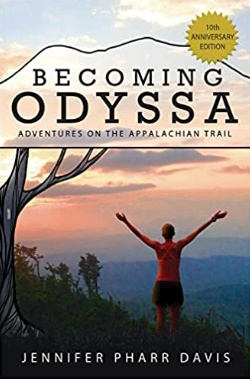
Jennifer Pharr Davis has a long outdoor resume including thru hikes on virtually every continent, the Women’s Fastest Known Time on the Appalachian Trail in 2008, then the Overall FKT on the AT in 2011. Becoming Odyssa is the story of her first adventure, hiking the AT in 2005, and how she became who she is. A masterpiece of the genre, in this book Pharr Davis lives and writes the trail story that many others will be measured by.
Becoming Odyssa is a great book because it is a rich book. First of all, it focuses on the hiking of a long-distance trail. Readers get an intimate sense of walking the AT. But there is much more than just hiking and scenery. The book is also about a young woman with little camping experience learning to live in the woods, and it’s about the making of a world class endurance athlete. The book has adventure, humor, drama, terror, nobility, philosophy, and transcendence. It is also full of relationships — social, platonic, and romantic. And all of this is delivered with high impact and no pretension.
Pharr Davis is a remarkable human being. Her zest for the trail and for life jumps off every page. But she is no Pollyanna. Open about her traditional Christian faith, she quickly learns that she is not on the trail to convert others, but to learn from them. A manifestly kind and reserved person, she writes unflinchingly about the realities of bodily functions, nudity, sex, profanity, drugs, and women’s issues on the trail. Dogmatic, prudish, or proselytizing she is not.
She admits early on that she feels driven to hike the AT, that it is a calling. A classics major in college, she re-genders another hiker’s suggestion and lands on the trail name “Odyssa” in reference to Homer’s Odyssey. Thus she begins a long process of coming to terms with her young life, journeying in search of a physical and emotional home.
The anonymity of trail names and the lack of hierarchy on the trail make honesty a core value of thru hiking and of Pharr Davis’ book. She is transparent about her own shortcomings, and cherishes many deep, one-on-one conversations with fellow hikers. She points out that the ephemeral nature of most trail relationships also enables their intimacy.
Despite her interest in other hikers, for most of the hike, Pharr Davis is committed to a solo experience. This exposes her to a string of impolite, unpleasant, and sometimes threatening male characters. Wincing through these encounters brings home to readers again and again the subtle and unsubtle harassment that women experience every day.
Nearly lost in the early story is Pharr Davis’ evolving athleticism. Soon we notice she is hiking 20-25 mile days. Then she adds in some 40-mile days. But she barely references this extraordinary level of fitness. Late in the book she mentions her three mph pace, surpassing most of the men on the trail, and we realize she is in front of the entire class of thru hikers for the season. But, until the final chapter documents her future record-setting endeavors, it is up to the reader to know that a trail star is in the making.
Pharr Davis’ prodigious strength is not only physical. It is mental and spiritual as well. When faced with the single most terrifying event I’ve ever read in a trail memoir, she calls for the police and considers leaving the trail. Then she collects herself and continues hiking, alone. Face to face with death, she doggedly continues to seek out life.
As an author, Pharr Davis seems devoid of literary pretension, committed to relating her story as simply as possible. Yet she delivers a very well-crafted book with creative and energetic writing. She’s particularly adept at reconstructing long, thoughtful dialogs with other hikers. There are also many well-written descriptions of her internal thoughts and debates. She tells us that the trail enables clearer thinking, less distraction, and more peace. Her book proves the point. I’m in awe of the authenticity of her reflections.
(If possible, listen to the audio version of the book. Pharr Davis’ spontaneous and playful narration adds much to the story. Her emotion at points is palpable, and the voices of her trail companions come alive.)
Never overwhelming readers with scenery, the book still offers a number of lovely descriptions. For me, the sensuous portrayal reflects an inherent reverence for nature itself. But for Pharr Davis the mountains are singing the praises of the Creator, and she is in communion. After a fearful night alone, her memorable description of an inspiring dawn where God speaks to her through the different hues of the rising sun, sparks deep emotion. Her love of natural creation is an easy point of connection for non-believers.
During a period of solitude traversing Vermont, Pharr Davis finds that to be entertained, she only needs to be still. Far from the oppression of a modern life’s busy schedule, she connects again with nature, hard work, and simplicity.
As she approaches the end of the 2000-mile-long footpath, she paints an intense picture of the sufferings of thru hikers as their bodies break down from the rigors of months on the trail. But she speaks for all trail lovers — day hikers, weekenders, and section hikers too — when she writes that the hardships of the trail make her feel far more alive, and beautiful, than the comforts of society.
Atop Mount Katahdin in Maine, Pharr Davis confides that she feels no epiphany, only happiness. Readers share in that feeling. Her book tells a great and entertaining story with understated gravitas. As we watch one human being discover her purpose, we feel that something important has transpired in the universe. In becoming Odyssa, Jennifer Pharr Davis finds a new identity that embraces not only the grueling Appalachian Trail, but all of a human life. She has journeyed home to her true self.
 Trail Memoir