
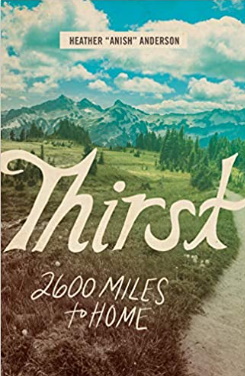
Heather Anderson, trail name “Anish,” went from being an overweight bookworm as a child to one of the most accomplished extreme endurance athletes in the world. She finished the 2600-mile Pacific Crest Trail in the astounding self-supported Fastest Known Time, male or female, of 60 days, 17 hours, 12 minutes.
How did she accomplish that feat? Her book may not give a clear answer, but it’s a fascinating portrait of a remarkable human being.
Like many driven people, Anderson experienced a young life of highs and lows. Before becoming a thru-hiking star, she was a model student on track for a career in ministry. Then she found God on her own terms in the Grand Canyon. She battled depression, went through a divorce, and realized she couldn’t meet the expectations of others and make herself happy at same time. She only felt whole while walking through the mountains.
Unlike some trail memoirs, Anderson’s book is nearly devoid of gear geeking, technique talk, or effusive scenery. We learn that she carries only six kinds of food, a high-tech tent, and minimal other equipment. And she orchestrates a near-perfect series of resupplies within walking distance of the trail, but makes other logistical mistakes like running low on headlight batteries, breaking a Steripen, and not planning enough calories.
Most importantly, we learn that Anderson is a world-class walker. She wakes at 5 am and walks about 3 mph until well after dark to cover 40 and even 50 miles in a day. She is brutally transparent about the suffering that entails: decaying feet, aching back, dehydration, lack of sleep, malnutrition, and hypothermia.
Her physical experience is the heartbeat of the story. Because it’s so extraordinary, that’s even more compelling than it sounds. And the narrative left me cheering her every step.
In addition to the punishing mileage, challenges on the trail include constant night hiking, electrical storms, river crossings, four mountain lion encounters, and a creepy guy in camo with a big knife.
What drives Anderson? She tells us she is “desperate for discovery,” addicted to new natural sights. She remarks that “digression is superior to dispassion.” It is better to be obsessive than a couch potato. In the end, her trek is about healing old wounds. Her scars are beautiful she writes.
Ironically, though nobody can keep up with her on the trail, Anderson’s story isn’t about getting away from people. She is eloquent about her need for connection, despite all that solo time. In fact, she’s desperate for interaction. She gets some via her Facebook postings, but finds that a single critical statement on social media can outweigh hundreds of positive ones, fueling her “internal foes.” Still she finds the process worthwhile to inspire others.
Anderson’s commitment is breathtaking. After one of several near breakdowns where she almost ends her quest, she vows to keep trying until she’s “lying in the trail with no ideas or energy left.” She is rewarded for her efforts with new powers, transformed into a lioness, no longer controlled by fear.
But one hike, however remarkable, cannot resolve all the issues in a human life. In the end, Anderson does not fully understand why she is wired to be happy walking long distances in the wild. She remains a ghost-like presence on the trail, fighting physical complications and depression when off it.
Unresolved questions aside, Anish had me rooting for her from the first pages. In the end I was a raving fan, screaming from my bleacher seat for her to break the record.
Her stoicism in overcoming Job-like trials made me seriously question my beliefs about my own limitations. What greater gift could an author or book give?
 Trail Memoir